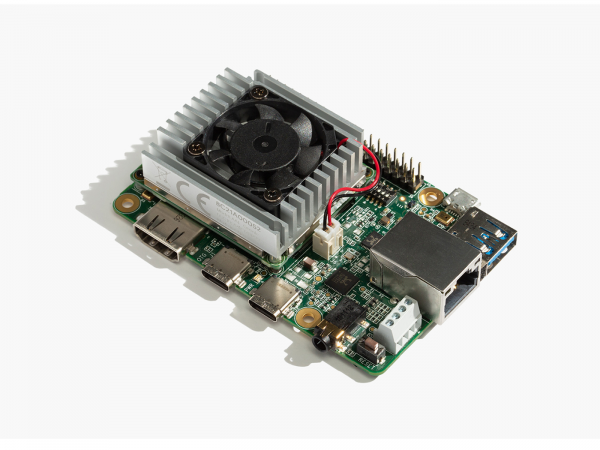
Overview
Coral Dev Board - 4GB RAM Version is a Google Coral Edge TPU device sold by Seeed Studio, rated by Seeed at 4 TOPS. Seeed publishes a fixed price for this configuration.
Key Features
- Coral Dev Board - 4GB RAM Version rated at 4 TOPS
- Performs high-speed ML inferencing: The onboard Edge TPU coprocessor is capable of performing 4 trillion operations (tera-operations) per second (TOPS), usi
- Provides a complete system: A single-board computer with SoC + ML + wireless connectivity, all on the board running a derivative of Debian Linux we
- Supports TensorFlow Lite: No need to build models from the ground up. TensorFlow Lite models can be compiled to run on the Edge TPU.
- High-speed and low-power ML inferencing (4 TOPS @ 2 W)
- A complete Linux system (running Mendel, a Debian derivative)
Ideal For
developers running quantised TensorFlow Lite models at the edge on an Edge TPU rather than a GPU
Performs high-speed ML inferencing
The onboard Edge TPU coprocessor is capable of performing 4 trillion operations (tera-operations) per second (TOPS), using 0.5 watts for each TOPS (2 TOPS per watt). For example, it can execute state-of-the-art mobile vision models such as MobileNet v2 at almost 400 FPS, in a power-efficient manner. See more performance benchmarks.
Provides a complete system
A single-board computer with SoC + ML + wireless connectivity, all on the board running a derivative of Debian Linux we call Mendel, so you can run your favorite Linux tools with this board.
Supports TensorFlow Lite
No need to build models from the ground up. TensorFlow Lite models can be compiled to run on the Edge TPU.
Supports AutoML Vision Edge
Easily build and deploy fast, high-accuracy custom image classification models to your device with AutoML Vision Edge.
Scale from prototype to production
Considers your manufacturing needs. The SoM can be removed from the baseboard, and integrated into your hardware. You can purchase the SoM separately here.
Feature
High-speed and low-power ML inferencing (4 TOPS @ 2 W)
Feature
A complete Linux system (running Mendel, a Debian derivative)
Feature
Prototyping and evaluation board for the small Coral SoM (40 x 48 mm)
Feature
NXP i.MX 8M SOC (Quad-core Cortex-A53, plus Cortex-M4F)
Feature
Google Edge TPU ML accelerator coprocessor
Feature
Cryptographic coprocessor
Feature
Wi-Fi 2x2 MIMO (802.11b/g/n/ac 2.4/5GHz)
Feature
Bluetooth 4.1
Feature
USB Type-C power port (5V DC)
Feature
USB 3.0 Type-C OTG port
Feature
USB 3.0 Type-A host port
Feature
USB 2.0 Micro-B serial console port
Feature
3.5mm audio jack (CTIA compliant)
Feature
Digital PDM microphone (x2)
Feature
2.54mm 4-pin terminal for stereo speakers
Feature
HDMI 2.0a (full size)
Feature
39-pin FFC connector for MIPI-DSI display (4-lane)
Feature
4-pin FFC connector for MIPI-CSI2 camera (4-lane)
Prices may vary. Verify on vendor site.
Quick Specs
- Performs high-speed ML inferencing
- The onboard Edge TPU coprocessor is capable of performing 4 trillion operations (tera-operations) per second (TOPS), using 0.5 watts for each TOPS (2 TOPS per watt). For example, it can execute state-of-the-art mobile vision models such as MobileNet v2 at almost 400 FPS, in a power-efficient manner. See more performance benchmarks.
- Provides a complete system
- A single-board computer with SoC + ML + wireless connectivity, all on the board running a derivative of Debian Linux we call Mendel, so you can run your favorite Linux tools with this board.
- Supports TensorFlow Lite
- No need to build models from the ground up. TensorFlow Lite models can be compiled to run on the Edge TPU.
- Supports AutoML Vision Edge
- Easily build and deploy fast, high-accuracy custom image classification models to your device with AutoML Vision Edge.
- Scale from prototype to production
- Considers your manufacturing needs. The SoM can be removed from the baseboard, and integrated into your hardware. You can purchase the SoM separately here.
- Feature
- 4-pin FFC connector for MIPI-CSI2 camera (4-lane)